Strike - music by Alloy Orchestra
Found in this wonderful guide to 420 free movies that you can watch online, Strike is a early communist propaganda movie by the director Sergei Eisenstein. His another well-known propaganda movie is The Battleship Potemkin and is also now in public domain. Both of them are silent movies and many bands has composed soundtrack later. He employed unique movie editing techniques that can be still seen in the movies nowadays.
One of the soundtracks available for the Strike movie was composed by Alloy Orchestra. Unfortunately, it is not available anywhere online and Alloy Orchestra sells it only as full DVD including the movie.
I have downloaded the movie Strike from Internet Archive and separated the audio track as a MP3 in 128 kbps quality. You can download it here: Alloy Orchestra – Strike.
I hope Alloy Orchestra will soon publish the full quality music (FLAC or MP3 320 kbps) of theirs on Bandcamp (or Amazon at least), so we can buy it online without requiring their fans to buy a DVD you will never watch.
October 4, 2011 at 20:42 :: Filed under Musings :: [*] :: No Comments ::
A Slovak branch of Strabag, a construction company, has sued the website www.znasichdani.sk (translates as From our taxes, run by Fair-play Alliance, won 1st Prize App prestigious prize of Open Data Challenge) that connects information available in the Slovak Trade registry with the awarded public sector contracts.
A slovak district court issued a preliminary ban (preliminary injunction) on displaying some information available on the website, which is an absurd case of judicial and corporate abuse as the information provided is already available on multiple public sector websites including information on Strabag and its managing director, Jarmila Povazanova.
STRABAG is committed to social responsibility and takes measures…
…measures to abuse its corporate powers and censor websites that try to defy corruption and display information on awarded public contracts. Well done, Strabag. Joining Deutsche Telekom in corruption?
June 27, 2011 at 15:51 :: Filed under Uncategorized :: [*] :: 1 Comment ::
I received a message from my friends in Vienna about a German couple that is on their way around the world… on bike. They asked me, if I would be able to host them in Bratislava. Am I able to host somebody cycling around the world? That’s a courage I like, so definitely: yes!
Andreas and Johanna came yesterday with their heavy duty bikes (really, weight of their luggage on bikes is around 60 kgs).
They liked Bratislava and today in the morning moved further on to the south of Slovakia by Danube river, unsure about where they are going to end. But sometimes, path is the goal, and in their case, traveling around, seeing new villages, cities, regions, countries or even continents, meeting new people seems to be way they like it. And yes, they will finally come back to Hamburg in two or three years, where their trip has begun.
So, good luck, guys and enjoy your great adventure!
March 31, 2011 at 23:40 :: Filed under Musings :: [*] :: 1 Comment ::
My friend teased me to retrofit a headlight on my old bicycle, so I accepted the challenge. After spending few bucks on small soldering iron, custom switch and a new ultrabright LED flashlight, I started to work on it. First, dismantling the whole thing, picking out a bulb and other small items included in the former dynamo light.
Then I took a battery holder from a small flashlight, combining it, gluing a custom switch to the opening where the dynamo wires were running through and a bit of soldering, putting it all together with a LED light circuit board. Trying to fit it all inside and all set, new bicycle headlight ready. Ultrabright front bike light retrofitted to the former dynamo front light.

Strong light - retrofitted bike light

Strong light - retrofitted bicycle light

Retrofitted LED bicycle light

Retrofitted LED bike light with a custom switch
Inspiration also from the Bicycle Safari blog.
March 1, 2011 at 20:48 :: Filed under Musings :: [*] :: 4 Comments ::
After spending some time creating a closed online community based solely around Google services, I have few recommendations for smaller groups on what online tools to use.
- Gmail – although well-known, it still helps to have a common email environment, when collaborating using Google tools. Not only because it integrates well with other Google services, but it also offers a Jabber-based chat called gTalk.
- Google Docs – allow for easy document sharing, can be used by multiple users at once (yes, editing one document (!) and seeing changes done by different people real-time). Goodle Docs integrate well with Gmail offering instant previews etc.
- Google Groups – as mailing lists are one of the oldest services on the internet, Google jumped in to the game with Google Groups. Interface could have some more time spent on over the years though, but it is still useful to have one mailing list that includes all collaborators. Google Groups feature the setting to have the every email forwarded or to receive a digest once a day (or even no email sent and reading done through the web).
- Google Forms – an extension to the Google Docs that offers user-friendly way to set up a reservation form, email subscription, contact form or even a survey.
- Google Maps – made famous by later introduction of extended Google Earth and the street view, Google Maps serve well for quick and dirty marking of city areas, addresses or other points of interest. Very useful for people not familiar with the area and possibly a good guide when the custom map feature is used.
I could have added Picasa or YouTube as well, but I am sure people will find the other useful Google services when needed.
January 25, 2011 at 19:55 :: Filed under Internet, Musings :: [*] :: No Comments ::
I’ve been using KDE since my final migration to Linux operating system in 2005. It used to be useful, although ugly looking environment in its first versions.
KDE version 3 set the standard and KDE version 4 has improved over it. But including inclusion of the Plasma desktop instead of experimental SuperKaramba used previously has demonstrated itself as two-edged sword. Although nice and potentially likely highly useful, Plasma has been plagued by many problems. Crashes used to be frequent in the first versions of KDE 4 and rarely they still happen. Overall feeling from KDE is that it is not integrated well enough. Every program uses its own notifications, there are many different ways how a user is informed about an event etc. KDE also feels sometimes rather unresponsive or heavy.
I have r
ecently tried using XFCE on a new desktop computer and it immediately felt lighter, faster and moreover, much better integrated. Everything seems to be well integrated in XFCE, icons, tooltips, pop-ups, notifications. Everything feels smooth and seamless.
KDE is now a giant slowly falling down under its own weight. I am really expecting what will the new version of KDE (number 5) bring.
Why I don’t mention Gnome? Because it’s way outdated, that’s why. And no, based on what I have seen, the Unity is not the right path to take either.
December 15, 2010 at 23:58 :: Filed under Musings :: [*] :: 1 Comment ::
The irony of how we use computers.
When the processor time was expensive, there was only one heavy computer with lots of terminals connected for access. Then the personal computers came and suddenly, everyone had to have one bragging about their hardware, processor type, memory size etc.
Then came the internet and with the broadband connections becoming ubiquitous and using more and more web applications our computers are becoming only end points. All (or most of the) data are stored in the server clouds and although available as a separate machine, we are using our computers as terminals without actual need for strong processor or large memory.
I guess it would be even cheaper to have an actual terminal and using miniSD card or USB flash key for those private data we don’t want Google (Microsoft, etc.) to have access to.
Terminal services paradigm seems to win in the end.
November 23, 2010 at 23:07 :: Filed under Internet, Musings :: [*] :: 3 Comments ::

New York City, Fall 2008
Folklore. That of New York consist of honking cars speeding in the streets. Red light or traffic jam? So what?! To honk here means to get done with your morning hygiene.
Saturday’s night belongs to fours. The fours of young girls walking on the streets, hailing taxis or getting out of them. Better living in quartet. Men should do the same thing, then, I guess.
November 20, 2010 at 03:21 :: Filed under Musings :: [*] :: No Comments ::
Bratislava was once a lively city with lots of different neighborhoods mirroring its ethnically mixed population. From 1918 until 1939, Bratislava was a part of the First Czechoslovak Republic, one of the few true democracies in Europe of those times. Enjoying its proximity to Vienna and having a direct tram connection from the city centre to the city centre, it attracted Wieners coming for culture and fun. The city centre as we know it today was only a small part of the larger city centre in that age – comprising also of Vydrica (home of the Jewish population and lots of well-known brothels) and Zuckermandel (the most western part of the former Old Town).
When the communists came with their sick idea(l)s, they decided to destroy the large part of the city centre after the World War II. They didn’t stop by the destroying of larger part of Zuckermandel and whole Vydrica, but also torn down the unique Jewish synagogue built in Moorish style that shared a wall with the St. Martin’s Cathedral. Communists sacrificed larger part of the former city centre to build the New Bridge. The bridge that was originally planned as a highway passing through the city centre.
There weren’t many regulations enforced after the fall of the communism in 1989 (so called Velvet Revolution) and the city of Bratislava (as well as the whole country) suffered from the widespread corruption without any exceptions in the field of construction. Many new buildings have been constructed without any consideration regarding their surroundings or people living nearby. Same early wild capitalism flowered in the late 1990’s and the beginning of 2000’s, often having citizens left out of the construction planning and comment phase by the corrupted city bureaucrats. Parks and green areas have been often sacrificed during these years leaving citizens with only two larger green areas in the city centre (Sad Janka Krala by Danube river and Medical Garden near the old cemetery).
Now, there have been lots of interesting new developments (Bratislava has been taken unprepared by the development boom during the past few years), some of them designed by the famous architects, some designed by the local ones. Some respected the number of storeys in the neighborhood, some ignored them attracting anger of the locals.
The explanation why many citizens of Bratislava are afraid of the new developments should be therefore clear already – history have taught them that most of the larger construction changes come with the destroyal of even older history, buildings and public spaces they once used to enjoy. The level of the past destruction brought fear of any new developments, specially when architects, developers and the corrupted city planners have been often caught trying to evade their duty to consult the neighbors during the planning phase.
Way out? A responsible developer should be prepared to do a few public hearings to better understand the fears and expectations of the future neighbors. They should be prepared to behave as they behave in their home countries (Austria, United Kingdom, Netherlands etc.), although local regulations often contain loopholes and could be worked around. They should also be prepared to keep the neighboring streets clean during the construction, which is again one of the frequent violations. And the last but not least, a responsible developer can do something for the community to fight the fear – maybe to plant more trees than regulations require or leave one of the green courtyards open for public to enjoy during the day.
October 11, 2010 at 21:40 :: Filed under Musings, Politics :: [*] :: No Comments ::
Facebook Comments Box Indexable and Crawlable by the Search Engines
SEOMoz community member Roy Peleg writes about how to make the Facebook comments (part of the Facebook comments box iframe) indexable and crawlable by the search engines including Google.
He links to a PHP script that basically pulls out comments from the API: http://www.rayhe.net/fb/comments.phps and inserts them into a page.
He writes:
However, trying to cloak (although having noble intentions) is just wrong in any case. Specially, when current methods and possibilities allow us to provide content visible only to the search engines. Instead of using the easiest way, Roy Peleg recommends one of the Google banned techniques.
What is the easiest way I am talking about?
Using the plain old
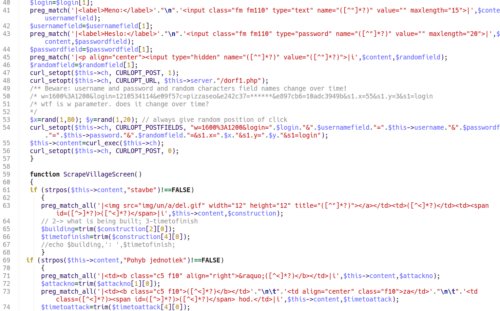
<noscript>element that is well suited for this purpose (search engines do not use Javascript, so they will “see” alternate content provided on the page):Easy, peasy and accessible, dear Roy Peleg.
June 16, 2011 at 11:37 :: Filed under Internet, Musings :: [*] :: 1 Comment ::